

The delight is in the details
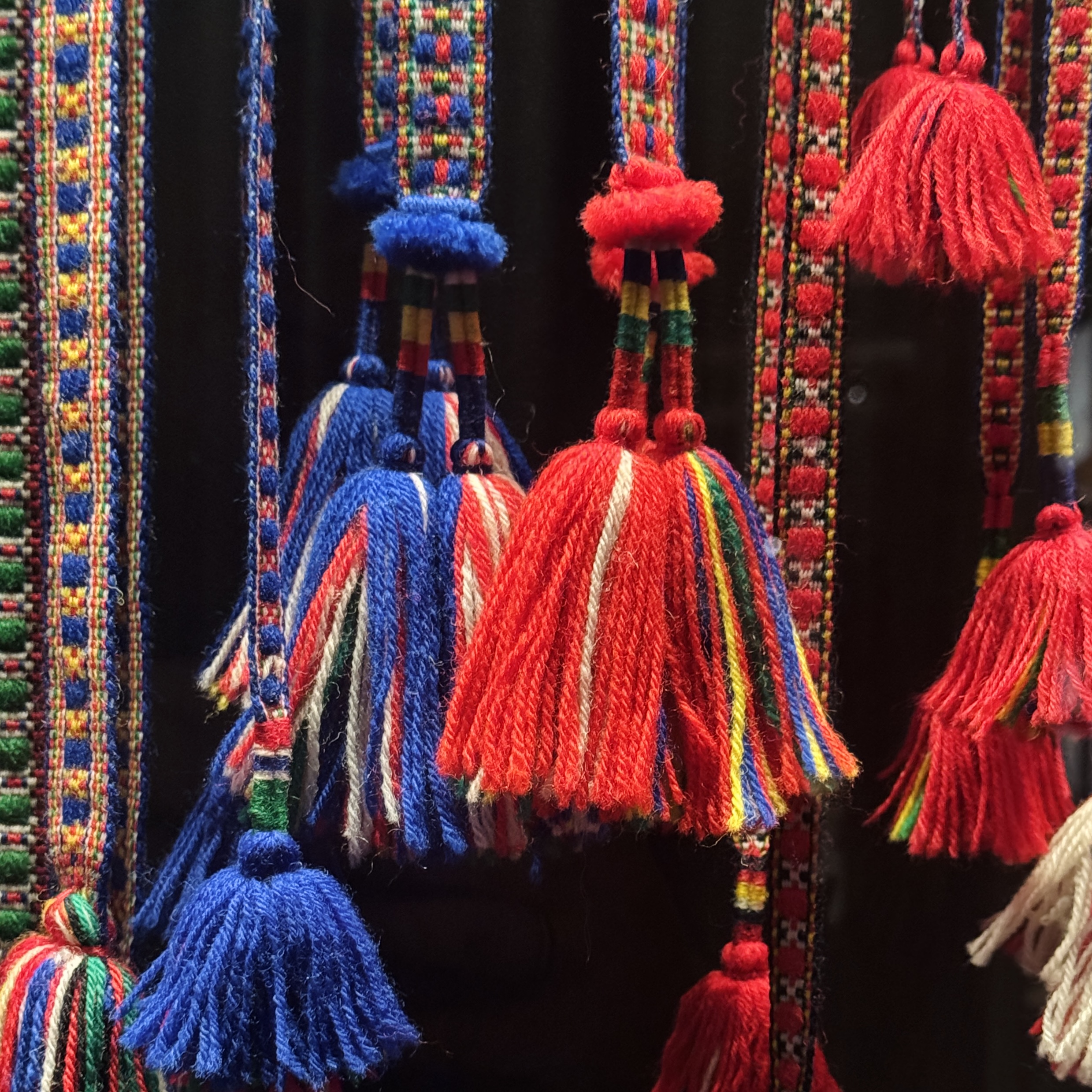
In the dark of winter, craft brings unexpected color. In this blog post, Mathilde Yakymets-Lind writes about the braids, bands, and mobiles they found on their trip to Sweden.
Above photo: Tassels on pick-up woven Sámi bands. Ájtte Museum, Jokkmokk. Photo by author.
I love handmade embellishments that surprise us with sparks of delight in unexpected places. A needlework flower nestled in the corner of a pillowcase, a sweet pulled-thread picot edge on a cuff, a hand-carved branch hook glowing with bright milk paint on a plain wall: these details remind us of the magic of the human hand in the mass-produced surround of contemporary life.
Sweden in winter is impressive in so many ways, from its warm Falun red farmhouses perched like cardinals in the snow to its abundant fika pastries (semla season is upon us!) to the walkable streets of Stockholm. On our Artisan Development Program trip this January, we encountered wildly talented artisans, were treated with perfect hospitality, and saw some of the best of the best of Swedish craft. I came away with my cup filled (likely with strong coffee!) as a craftsperson and lover of material culture. How to capture such a rich experience? I decided to focus on some small details that bring unexpected color into the everyday: braids, bands, and mobiles that create warmth and movement in the dark season of the Northern year.
Braids and bands
Nordic minimalism? No no! Sweden was aglow with embellishments. Everywhere we looked, there were delightful details: hanging lights in the windows, beautiful stitching on the textiles, meticulously faceted woodcarving, colorwork mittens, and on and on.
I marveled at many complex, finely woven bands and belts in Sweden, but to me, the most astonishing thing about them was the finishing work. The bands show a variety of techniques and are often finished with tassels and braids. At the end of a band, the weavers often split the warp threads into 2-4 braids and finish each with a tassel and sometimes beads. The split itself is also often covered with fringe. Pick-up and fingerwoven bands from Sámi people were some of the most exciting to me, and the Ájtte Museum in Jokkmokk has a stunning display case of them. Of course, I took home a book on Sámi fingerweaving and some yarn from Stoorstålka, and I have been churning out little samples ever since.
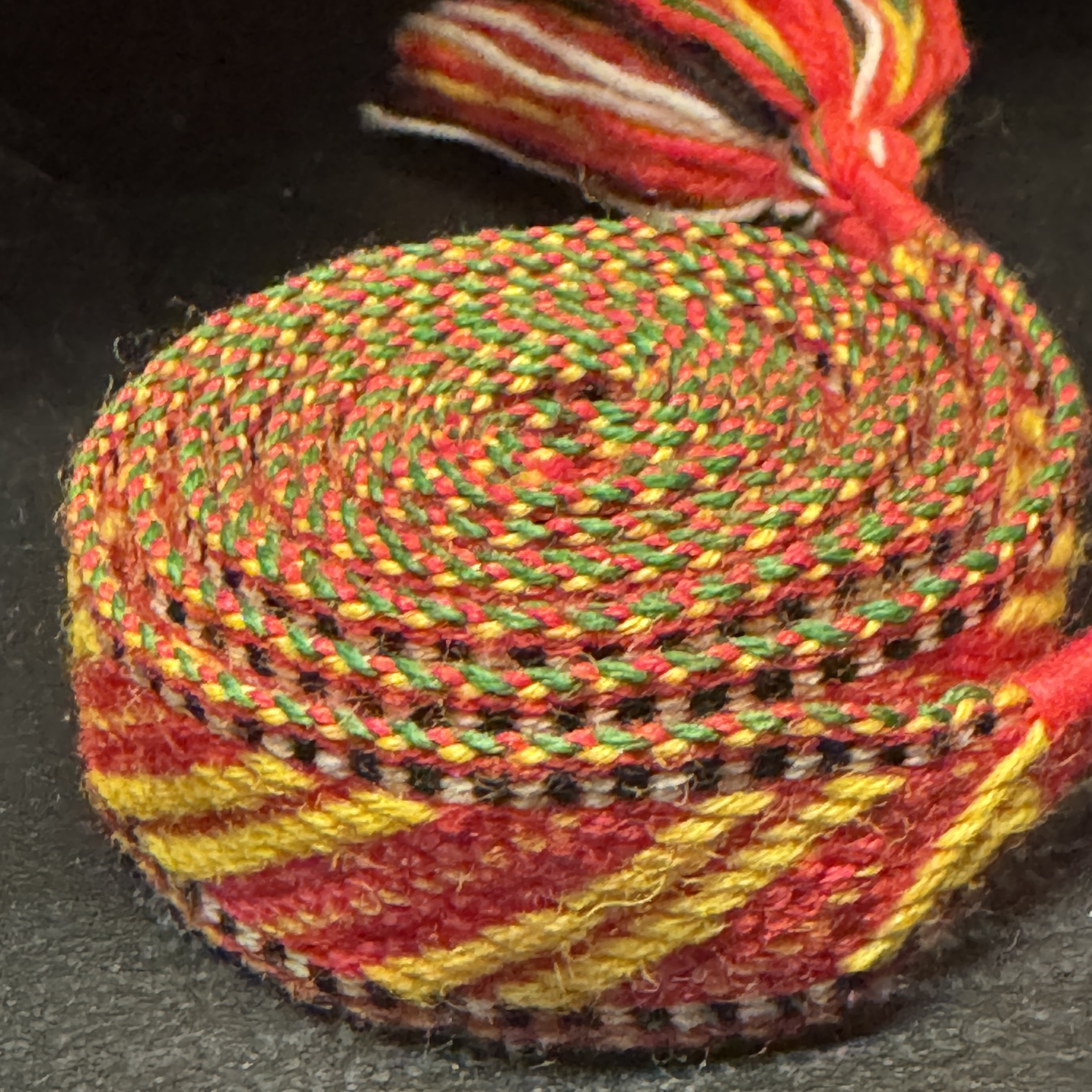
Above: Sámi pick-up woven band. The edge has a single green strand that creates a subtle decorative border. Ájtte Museum, Jokkmokk. Photo by author.
Another great center for handwoven narrow wares is Dalarna County, where they have a special band loom for weaving almost impossibly intricate ribbons. Going to Dalarna is like a pilgrimage for a folklorist like me; it is renowned for its material culture and its massive role in the history of folklore studies. Dalarna’s traditional culture inspired figures like Ottilia Adelborg, a founding member of the Swedish Handicraft Association (Föreningen för svensk hemslöjd, formed in 1899), to document daily life, collect folk art, and set up local institutions to safeguard traditions. The Dalarna Museum opened to the public in 1892, and it was astonishing to be welcomed by Dalarna’s handicraft consultants, Fredrik Eriksson and Kattis K Hofvander, and go into the collections of this legendary institution.
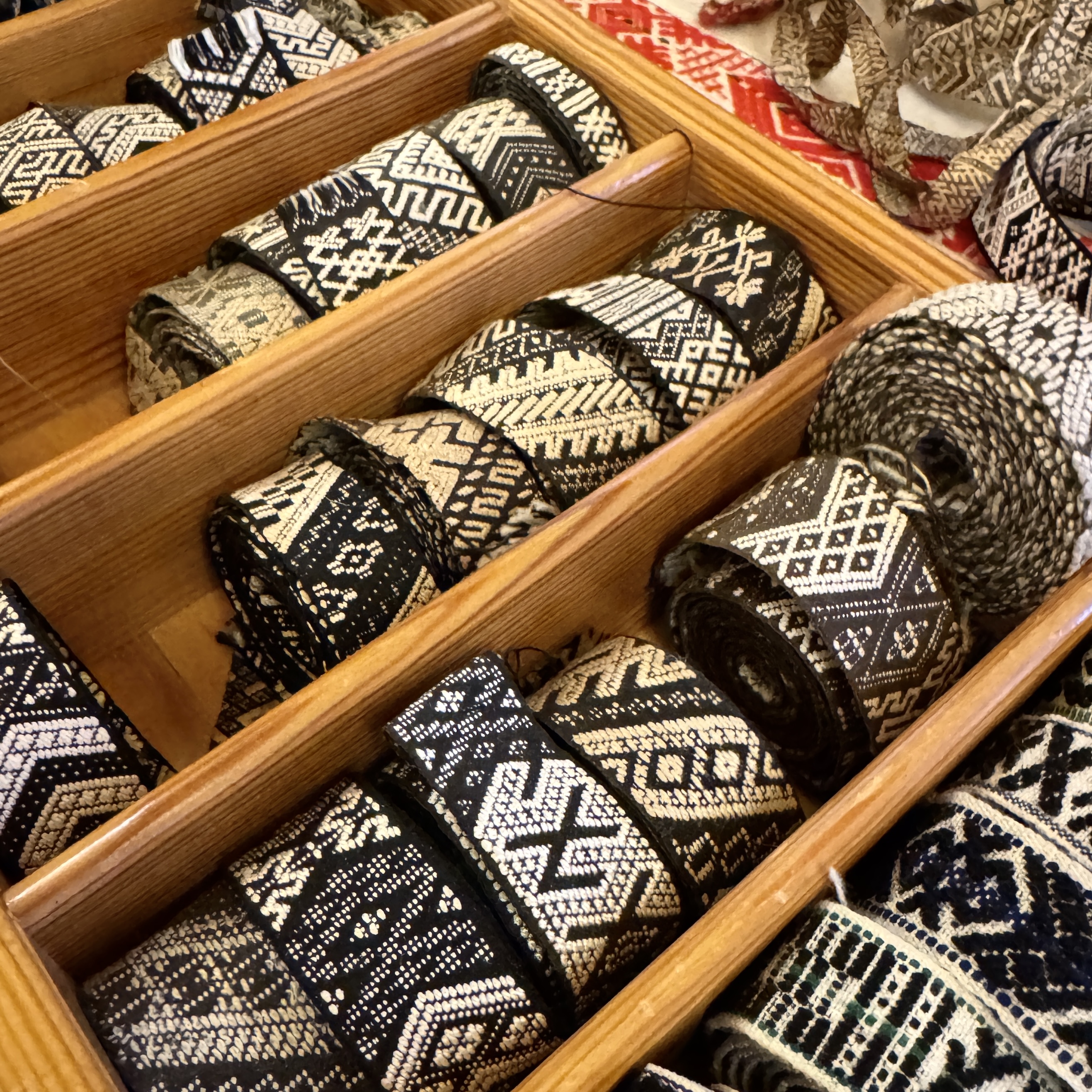
Above: Woven ribbons from Kirsi Manni’s collection, Leksand. Photo by author.
One of my favorite parts, though, was finally meeting Kirsi Manni in Leksand after being friends on social media for many years. Kirsi is an absolute powerhouse as a craft researcher, collector, and artisan, and we got to see her home studio and handle her handmade reproduction Leksand cape. She showed us her collection of local band looms and woven bands. Her handwork is simply on another level! I was in awe during the entire visit and could have spent days there. Even better, she is kind, open, down to earth, and has a magical ability to make others as enthusiastic as she is about the handwork she studies and practices.
Mobiles and ornaments
The other exciting theme for me throughout the trip was finding mobiles and other hanging ornaments virtually everywhere we went. In the United States, we often associate northern European mobiles with Finnish himmeli, made mainly from straw, while mobiles with embellishments like cut paper are more often associated with central Europe, especially Poland. Unexpectedly, I found that the Swedish ones can be made from any number of materials. Most of my favorites were adorned with little pieces of wallpaper (called tapetkrona, or wallpaper crowns), but my absolute favorite was in the Dalarna Museum and was made from birch polypore, a type of shelf fungus! Overall, hanging ornaments seemed to be ordinary features of indoor spaces, at least for people in the craft world. I found them spinning in humble places like the corners of offices and kitchens, not just in more visible public spaces.
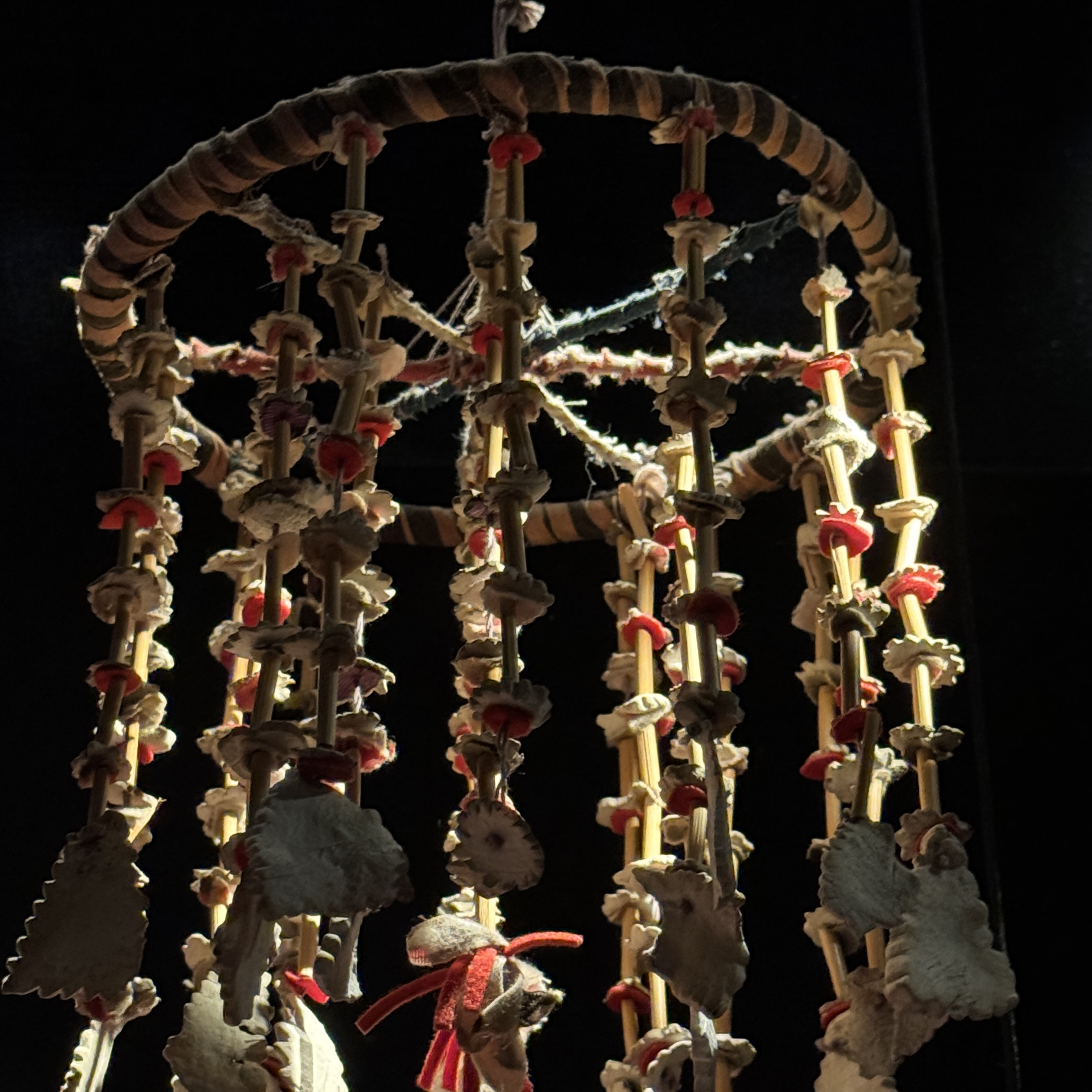
Above: Mobile made of birch polypore, straw, and fabric. Dalarna Museum, Falun. Photo by author.
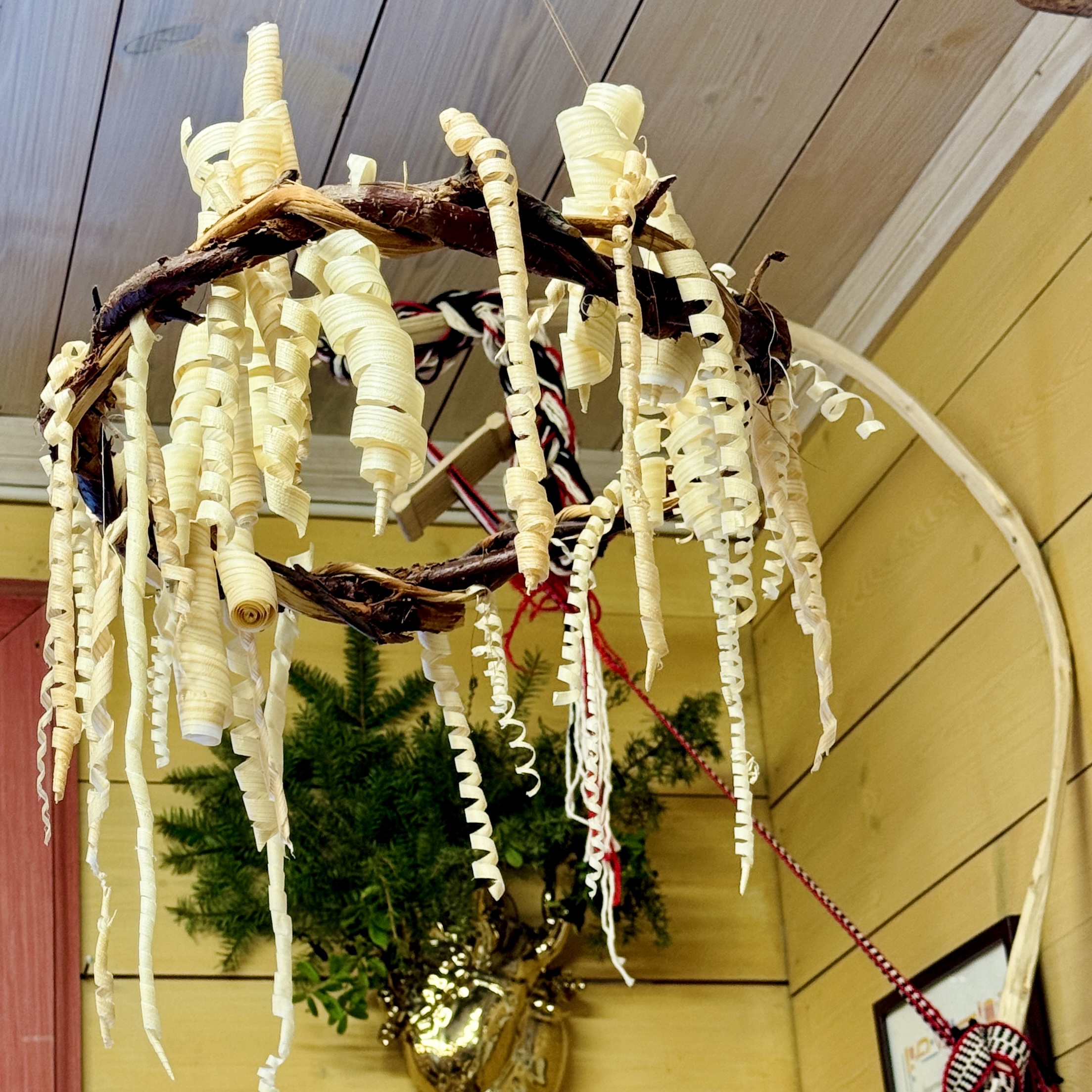
Above: Mobile made from wood shavings. Sätergläntan. Photo by author.
As I write this, I am en route back to Minnesota, and I have been preparing to teach a sampler class for Fiber Week on plaited ribbons and woven bands. I’ve been thinking about how to combine narrow wares like these with mobiles. My inspiration is one of the simplest mobiles I saw in Sweden, which just features a hoop with scraps of fabric hanging from it. It reminds me of the tutt, a tassel made from scraps of colorful cotton fabric used on fingerwoven belts on Kihnu island, Estonia. I’m thinking about attaching my many colorful sample braids to a hoop and hanging them as a little mobile when the class is done.
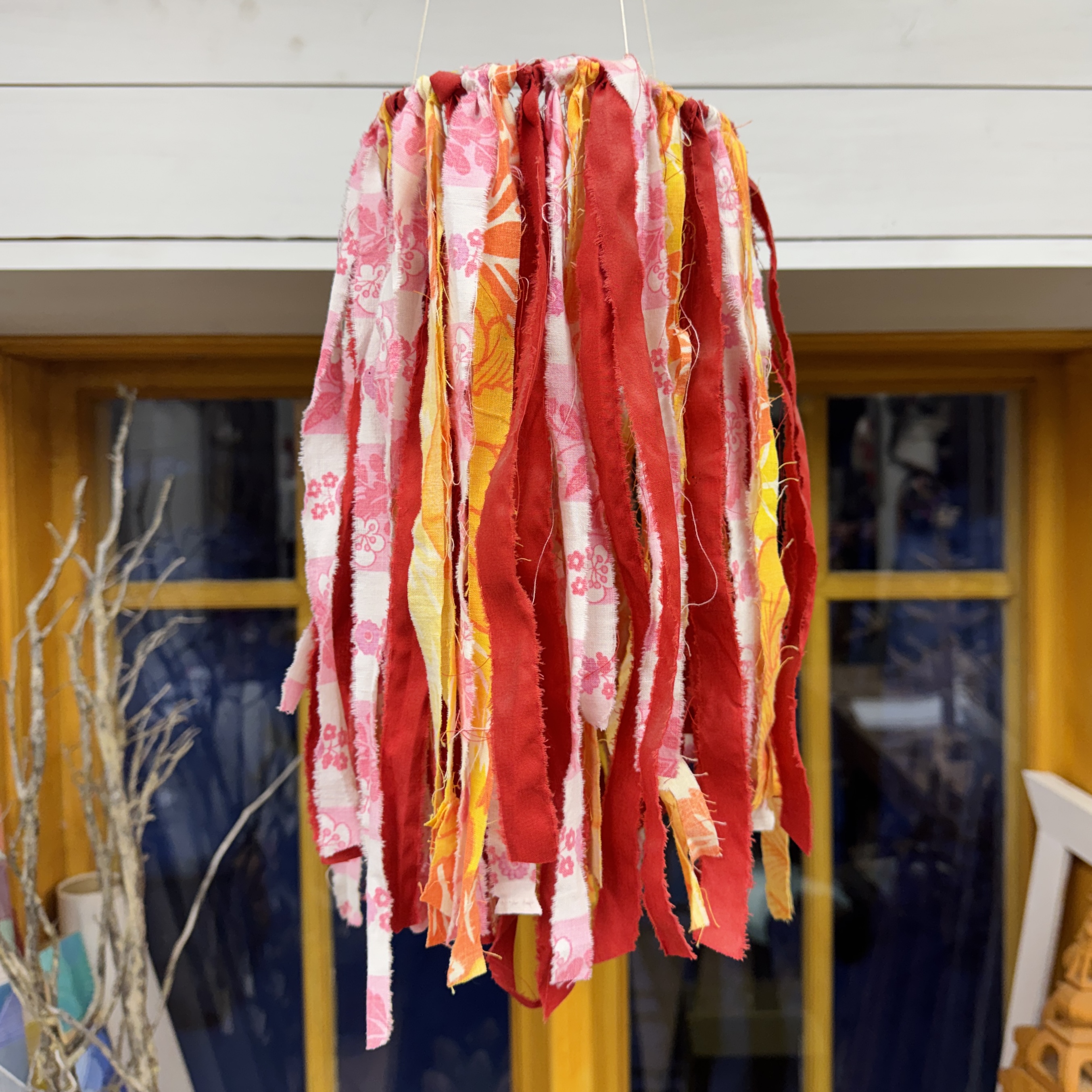
Above: Mobile made of strips of cotton fabric. Beth Moen’s studio, Leksand. Photo by author.
The harmony of handwork
The handmade embellishments I saw in Sweden made me reflect on how ornaments often do not register as individual items. Instead, they come together to provide color and texture in folk dress and domestic spaces. Zoom in, and you see the details; zoom out, and there is light and movement that pleases the eye but can be difficult to describe.
While at North House, two practices with a similar quality have become increasingly important in my life: mobile making and community singing. The trick of a mobile or a choir is that there can be flaws at the individual level, like bent straw and rough voices, but if you put enough of them together, all you get is harmony (never uniformity!). This is another way to find beauty in the details of craft: the little flaws of natural materials and inconsistencies of handwork become joyful variety and texture when taken as part of the whole cloth of the everyday. Likewise, people in our infinite varieties, including those of us who see ourselves as difficult or flawed, are all part of the balance and rhythm of community, making together, singing together, and sharing the labor and delights of life on Earth.
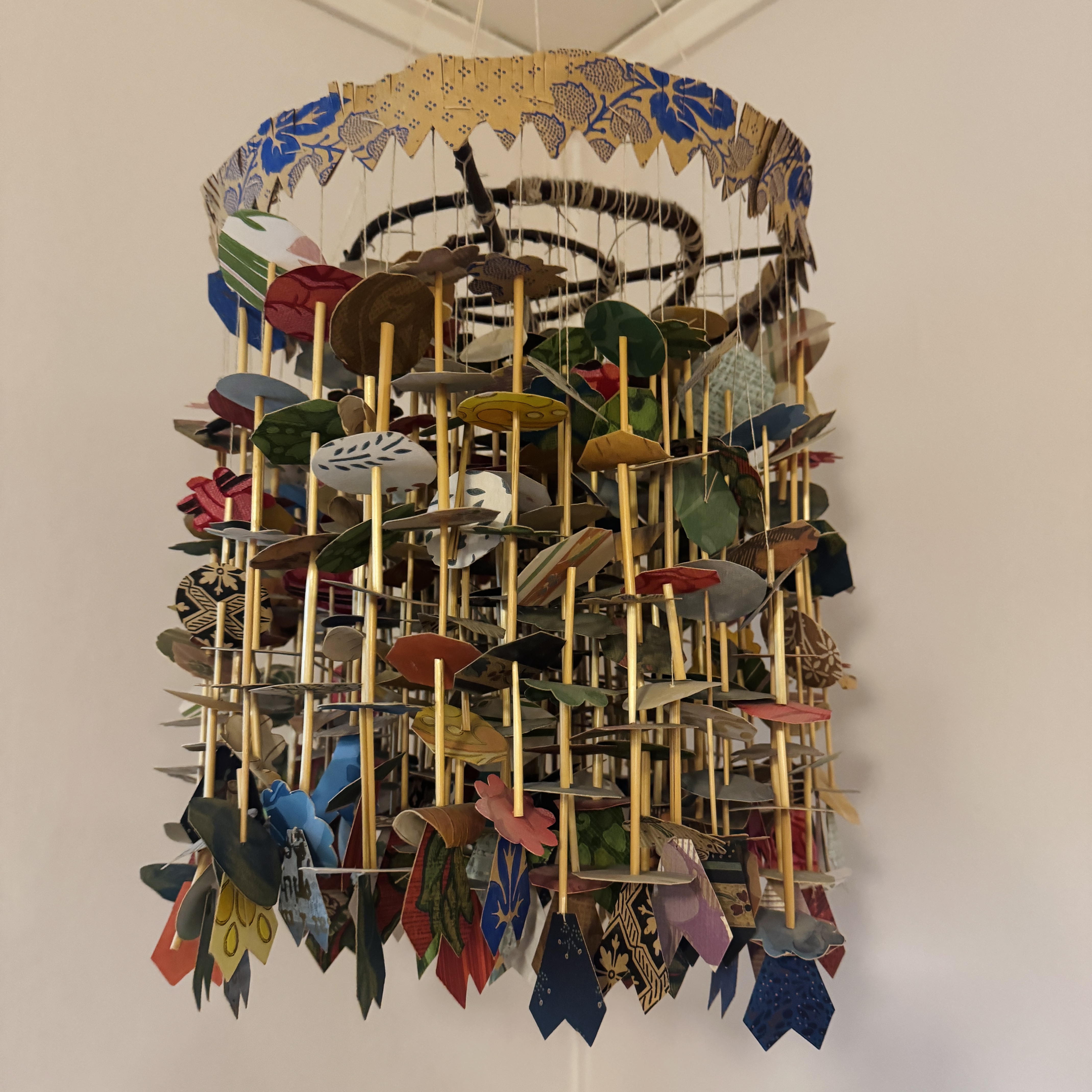
Above: Tapetkrona (wallpaper mobile), Sätergläntan. Photo by author.