

Inez Attemark's spinning wheel
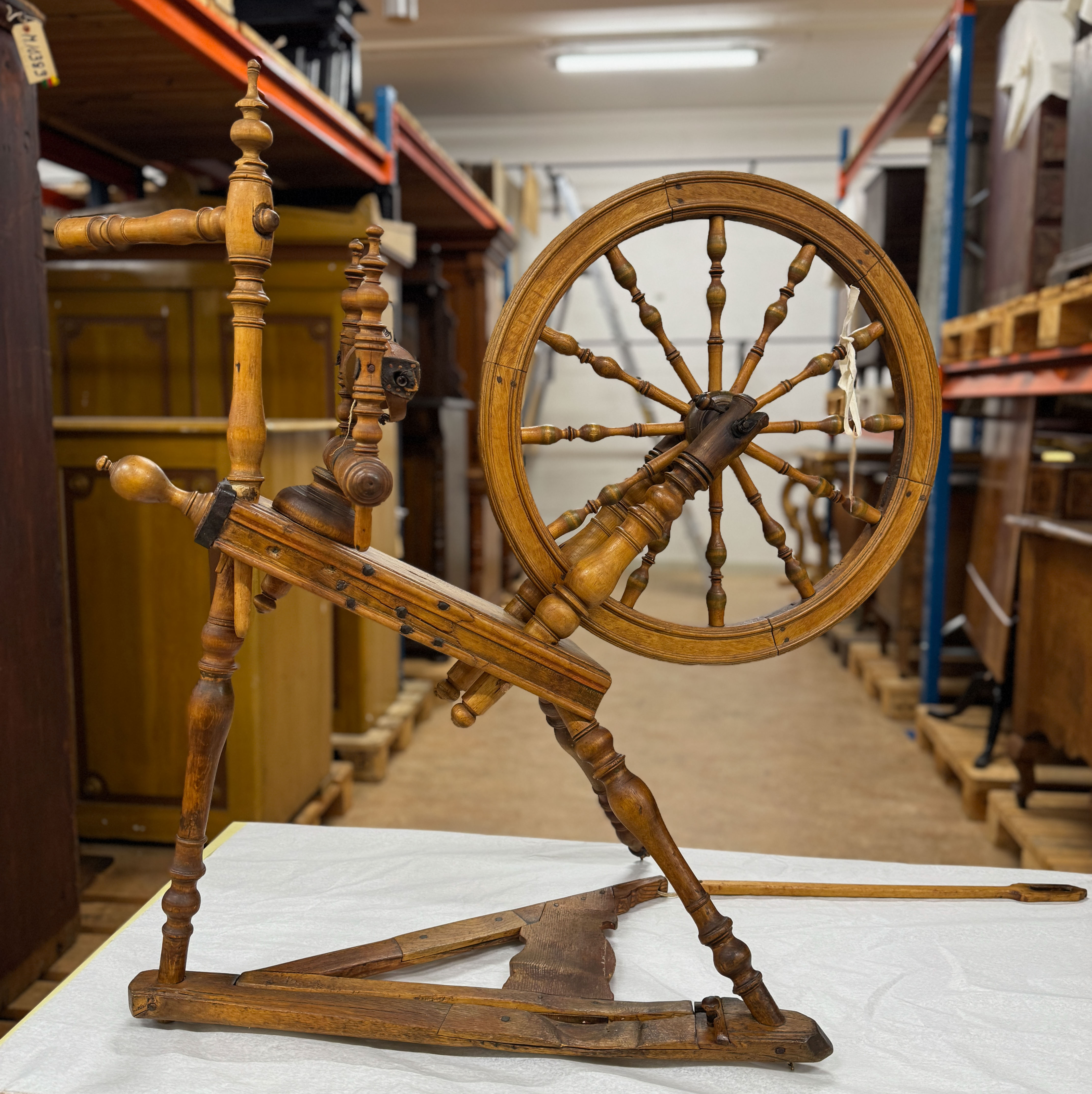
The tools we use bear our stories. In this blog post, Mathilde Yakymets-Lind writes about a well-loved spinning wheel they saw in Sweden and shares the story of Inez Attemark and her relationship with this wheel.
On our Artisan Development Program (ADP) trip to Sweden this January, we visited Härnösand, a small city overlooking the Gulf of Bothnia in western Sweden. There, I encountered an old spinning wheel in the collections of the Västernorrlands Museum that moved me with its many marks of loving care.
It is a medium-sized wheel with a strongly slanted table. Its delicate turnings enhance the sense of lightness and motion in its form, as though the spinning wheel were about to take flight. The treadle design is particularly interesting, as it includes a clever latching system to remove the entire treadle and clean and lubricate the pivot points.
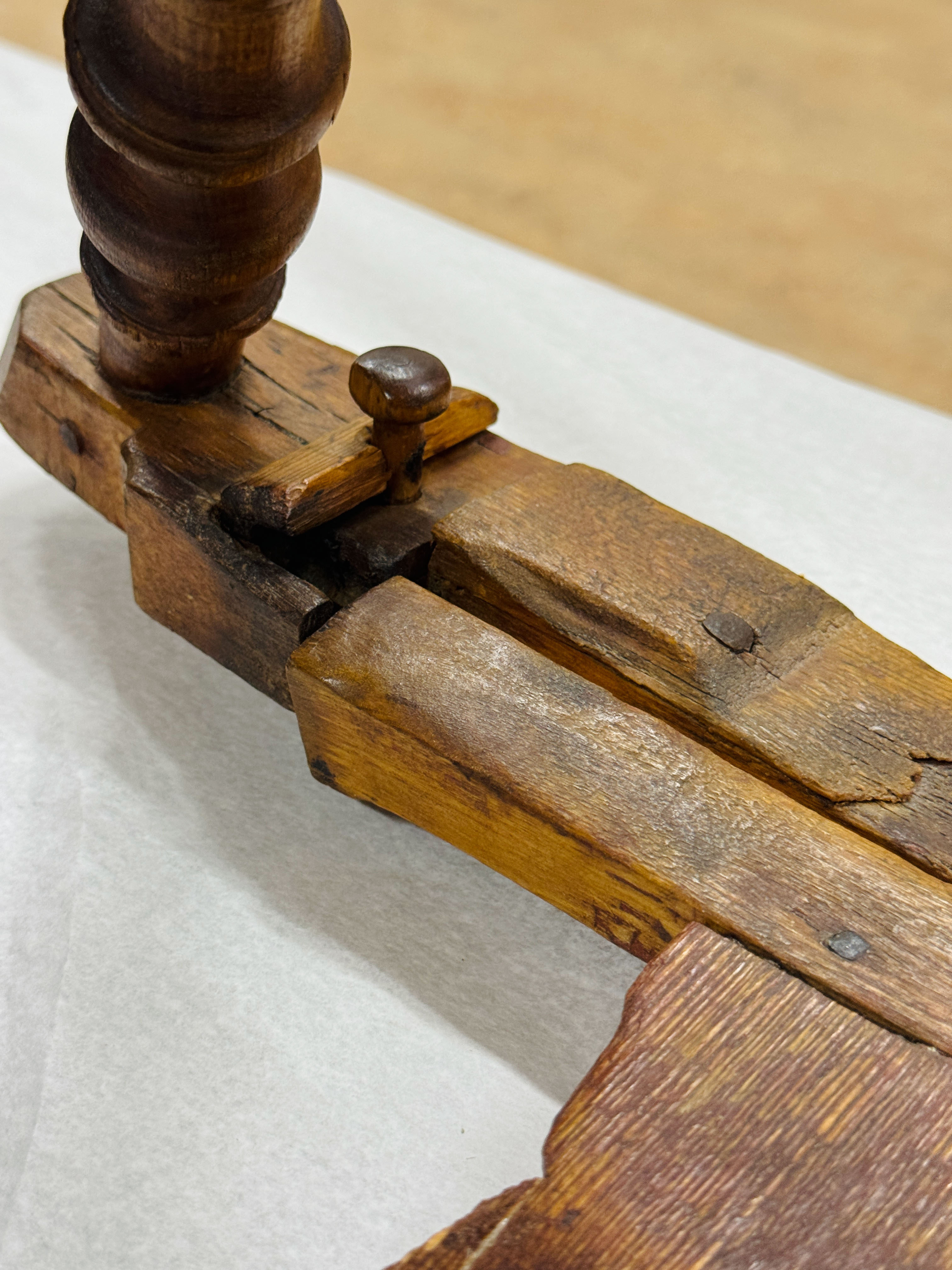
This latching system allows the entire treadle to be removed for maintenance. Photo by author.
A date on the underside of the spinning wheel's table reads 1815, and there are signs that it was a hardworking tool for much of its life. There is a dramatic split in the table and multiple repairs to stabilize it: seven large hand-forged iron nails were hammered into the side, and a forged iron band was fitted tightly onto the table end and nailed into place.
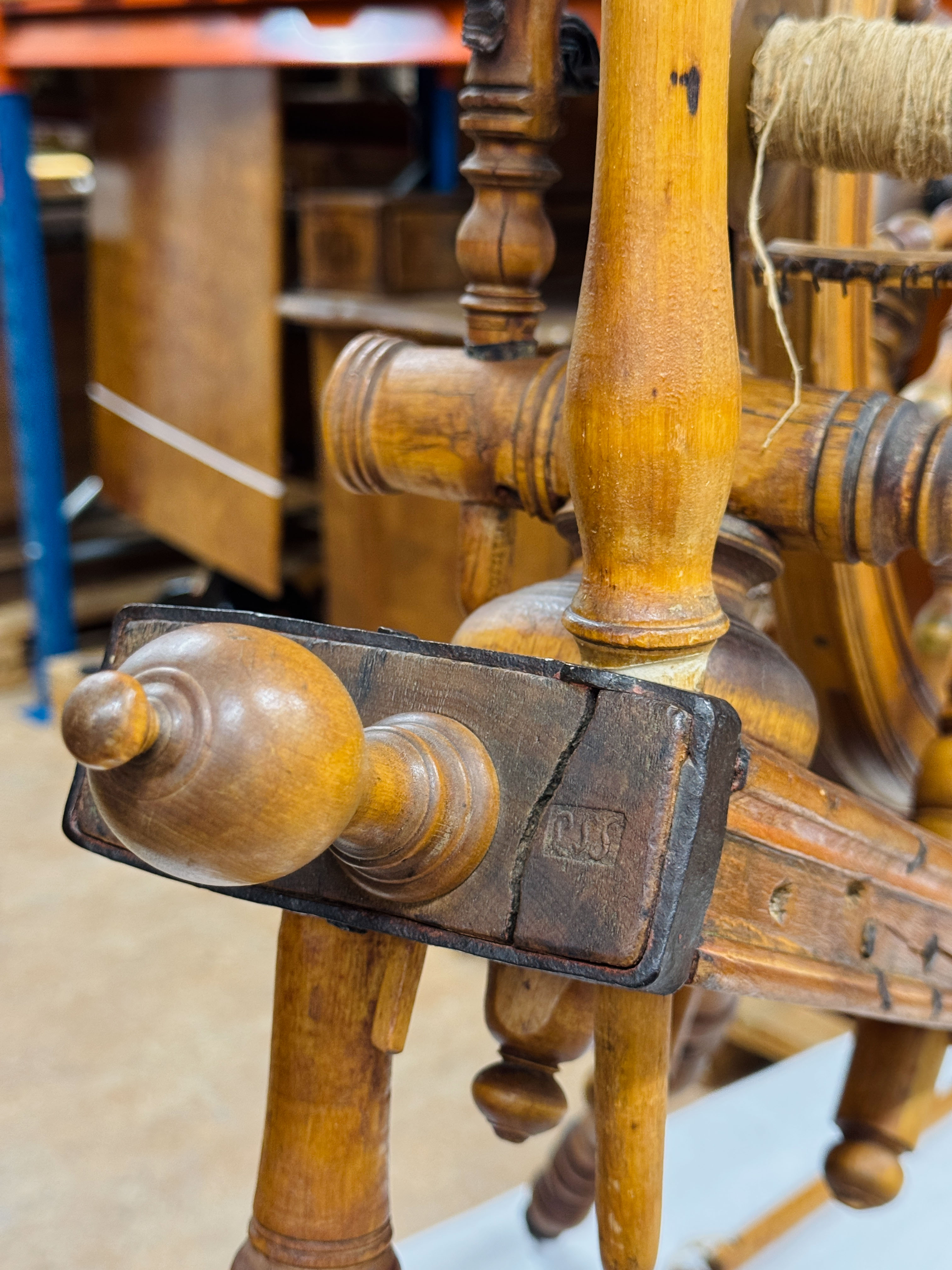
A large crack in the table, or the large block of wood that forms the main body of the spinning wheel, is stabilized with iron nails and an iron band. The maker’s mark is stamped into the end of the table. Photo by author.
The feet of countless spinners have worn a portion of the treadle bar almost through. The leather bearings that hold the flyer are also worn, and someone reduced the diameter of a too-large bearing hole by adding an extra piece of leather. Dark oil stains and worn wood show that it was maintained and cared for as an important partner in domestic labor and folk craft for generations, finally ending up in the hands of its last owner, Inez Attemark (1920-2012).

200 years of wear from many hardworking feet can be seen on the treadle of the spinning wheel. Photo by author.
When Inez was six years old, her parents, Elin and Johan Arvid Bylund, bought the spinning wheel for her at an auction. Marked with initials (possibly a maker's mark) on the end of the table, a family mark on top, and the inscription IPS 1815 on the underside, the wheel was old, fascinating, and full of stories. It was already 1926 when they brought the wheel home, long past the point when mills had taken over textile production in Sweden.
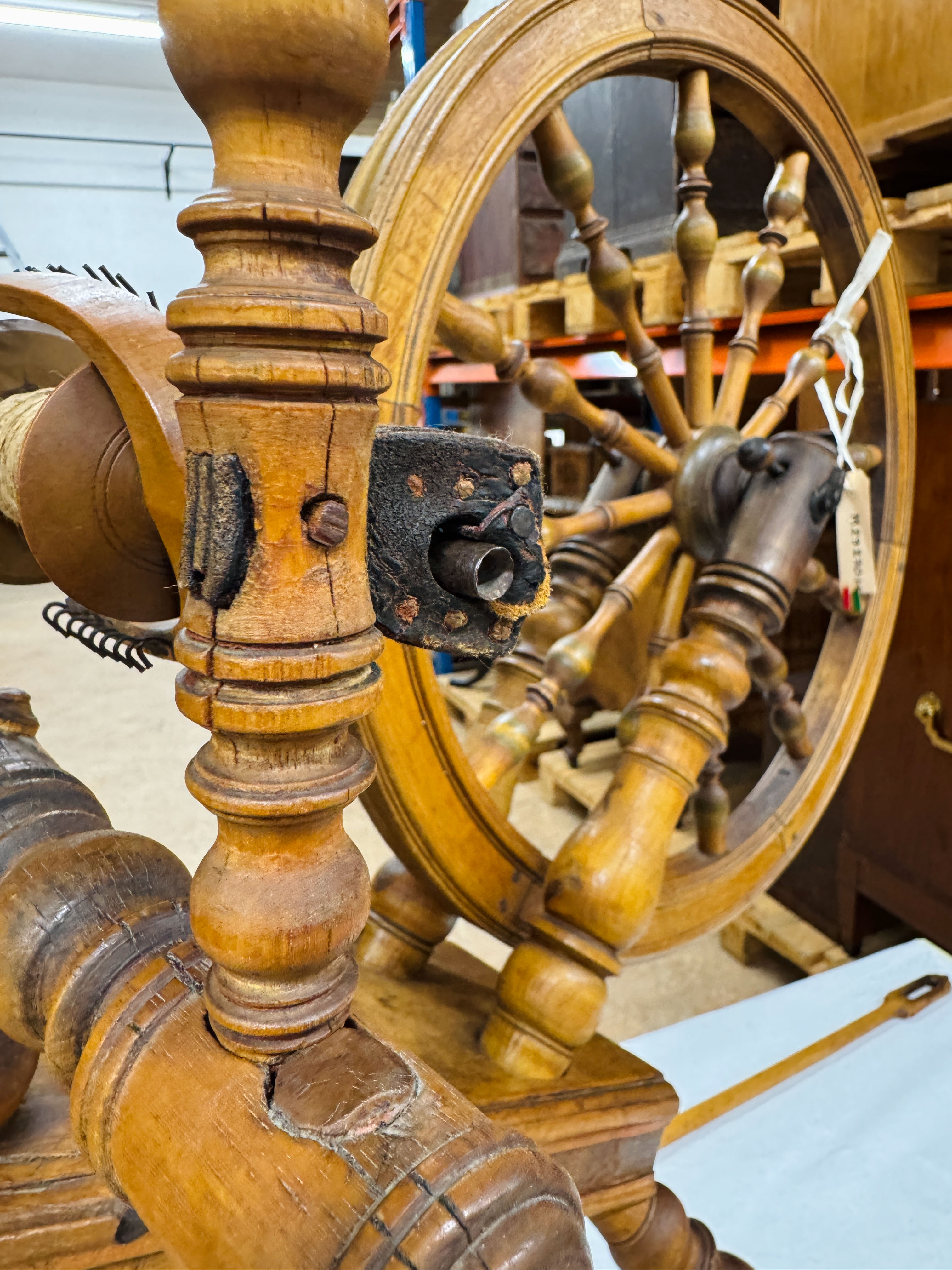
An extra scrap of leather was nailed onto the flyer bearing to reduce the diameter of the hole, which was worn loose over the years. Photo by author.
Inez became a proficient artisan at an early age. At just eight years old, she won an award for her needlework at a handicraft exhibition and traveled with her parents from their home in Svarvarböle, Hässjö parish to the nearby city of Sundsvall to receive it from the governor.
Around the age of 14, Inez lost her father, and the resulting financial hardship for her family forced her to leave school and move to Härnösand to work as a maid. As the oldest child of five, she had to support herself and give up much of the handwork that had given her pleasure. After two years of hard work, she moved to Stockholm and found employment in a pastry shop. In 1942, she married, giving up her job to move across town and start raising children, but she returned to textiles later.
Now that life was more settled, she could find time for handwork again, so she joined a vävstuga (weaving group) and rented a loom to weave carpets. Inez passed away in 2012 after a long life dedicated to family, work, and craft. In her final years, the spinning wheel of her childhood made its way back to Härnösand as a donation to the Västernorrlands Museum, reuniting it with the living craft community of her home region.
There is so much we do not know about this spinning wheel: who was the maker? Where was it made? Who used it before Inez? But still, we have so much: here is a beautiful old tool, made and kept with care, and here is a story of one woman's life in relationship with that tool. Through her generosity, the spinning wheel has returned home, waiting quietly in collections storage for those who know how to read the story etched into its body.