

Hej from Sweden!
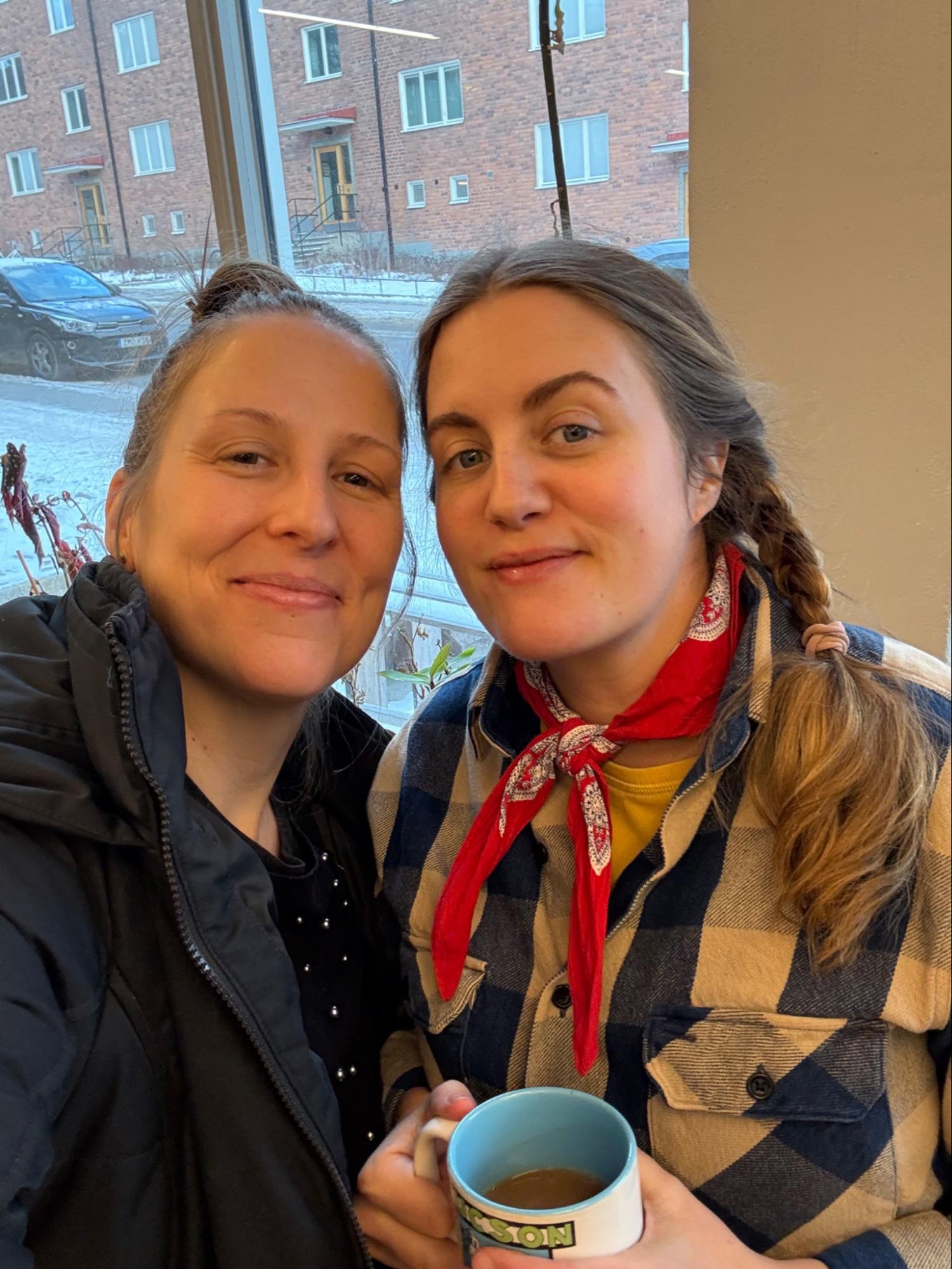
As weaver Josie Cooke traveled through Sweden, a set of questions guided her journey. How did people make textiles long ago? What does it mean to continue these crafts? And what will her contribution to the story of textiles be?
Today I fly home, over the deep valleys and mountains of Norway, the fields of heather and rock of Iceland, and the frozen plains of Labrador. For three weeks I have been exploring Sweden—the Scandinavian journey part of the Artisan Development Program.
The first ten days we travelled as a group: the other three artisans in my cohort, two members of the staff (Executive Director Greg Wright and Grants Manager Libby Larson), and lead instructor Tasha Miller Griffith. As a group, we spent time in Stockholm, Dalarna, and Härnösand, visiting friends and artisans, dancing, carving, knitting, and fika fika fika. This trip has given me the opportunity to meet deeply knowledgeable craft consultants, explore museum archives, and expand my understanding of Scandinavian history and craft.
As a textile person, this trip was absolutely thrilling. Being in a country with a long, unbroken tradition of handmade textiles (before industrialization) provided an opportunity to see prehistoric tools, 500+ year old clothing and embellishments, as well as many incredible examples of craftsmanship and ingenuity.
In some ways it felt like an exploration, much like a mystery or crime novel. I found myself searching for clues and asking questions like, “What were people using to create their fabrics long ago?” “When and how did looms spread from one region to another?” “What was commonplace clothing like in different eras, who was making it, and how was it worn?” “What does it mean that we do these crafts today, and how do we build on the knowledge of the past?”
On this trip—as I explored museums and met weavers, tool makers, archivists, curators, craft consultants, and craftspeople involved in historic garment recreation—new areas of understanding were illuminated. Like pieces of a puzzle put into place, a picture is being formed. In this picture, the answer isn’t typical of a mystery “whodunit” style; instead, the central questions remain: How do I fit into this tradition of creation? What contribution do I make to the continued story of craft and textiles? And what can I learn from the past to build on and bring into the future?
Here I share some bright moments from the trip:
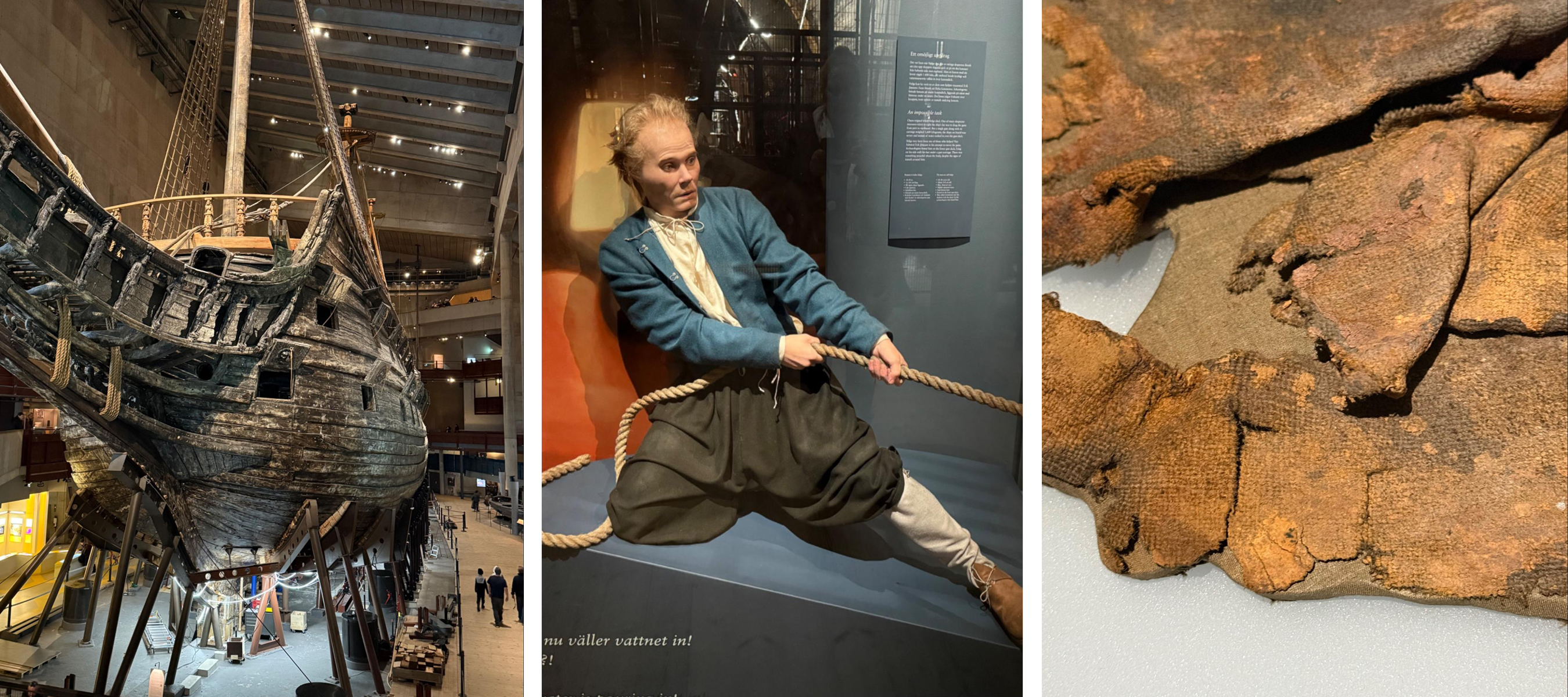
The Vasa Museum houses an absolutely massive ship from 1628 that sank on its maiden voyage, where it stayed for 300 years, a well-preserved glimpse of life as it was then. Artifacts included tankards, chests, wooden bowls and spoons, money, games, and thirty unfortunate souls who went down with the ship. One man, Helge, was found near a canon, possibly with his foot caught beneath it. His clothing included a twill woven jacket and plain weave knee-length breeches. Seeing these clothing examples provides context to what people used to wear, everyday, long ago.
Linen had an abbreviated history in our country, but has long roots in Scandinavian culture. Several moments on the trip offered an opportunity to see and understand so much more about the history and current practice of linen production.
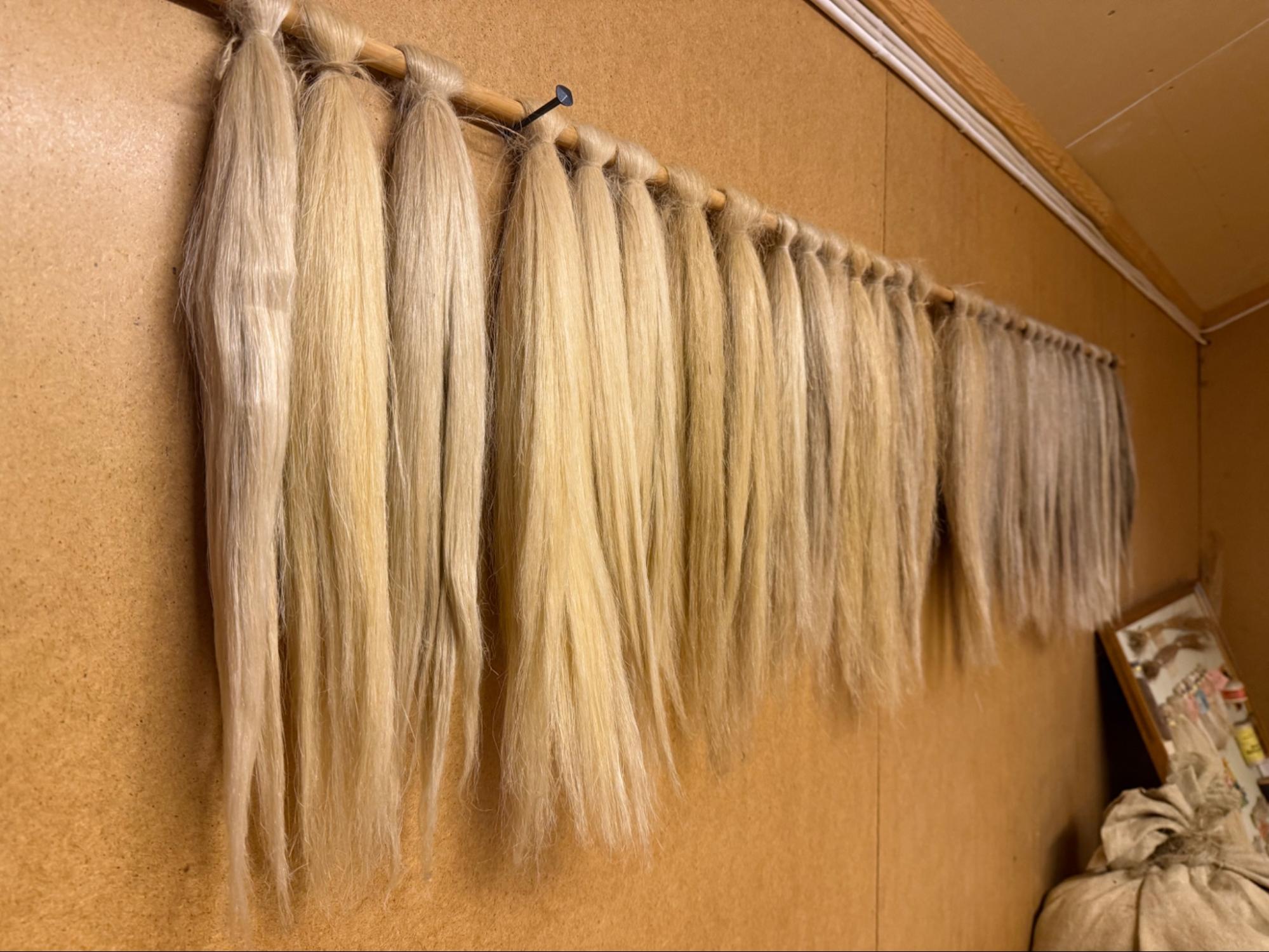
At Sätergläntan (a folk school in Dalarna offering study up to three years), we got to see their flax processing equipment and touch the processed but unspun flax. It was eye-opening to be able to feel the fineness of the material before it becomes thread to be woven—to understand that level of refinement is possible. It brought home the phrase ‘flaxen hair.’
Tools for linen weaving include the hackle (to remove the chaff from the stalk and extract fibers for spinning), the distaff (to hold your unspun flax while you are spinning), and the mangle (to press your woven linen as a finishing technique). These tools are both historically useful and intricately embellished, particularly the mangle, as they were given as courting and marriage gifts. Not only is the craftsmanship in decorating these tools impressive, but it speaks to how important these materials were in people’s lives—to warrant the time and skill required to make them so beautiful.
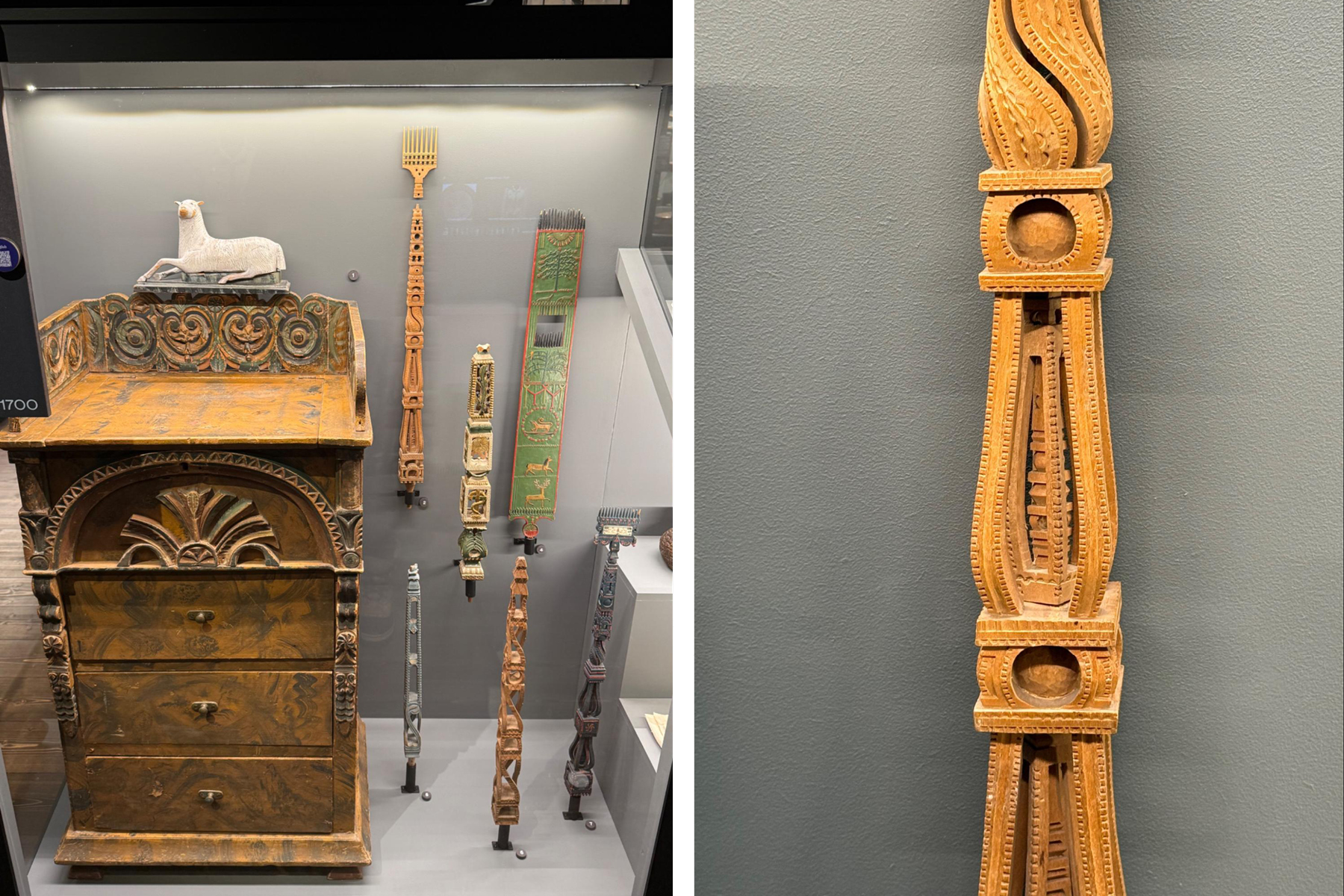
Above: Distaffs and mangles from the Dalarna Museum
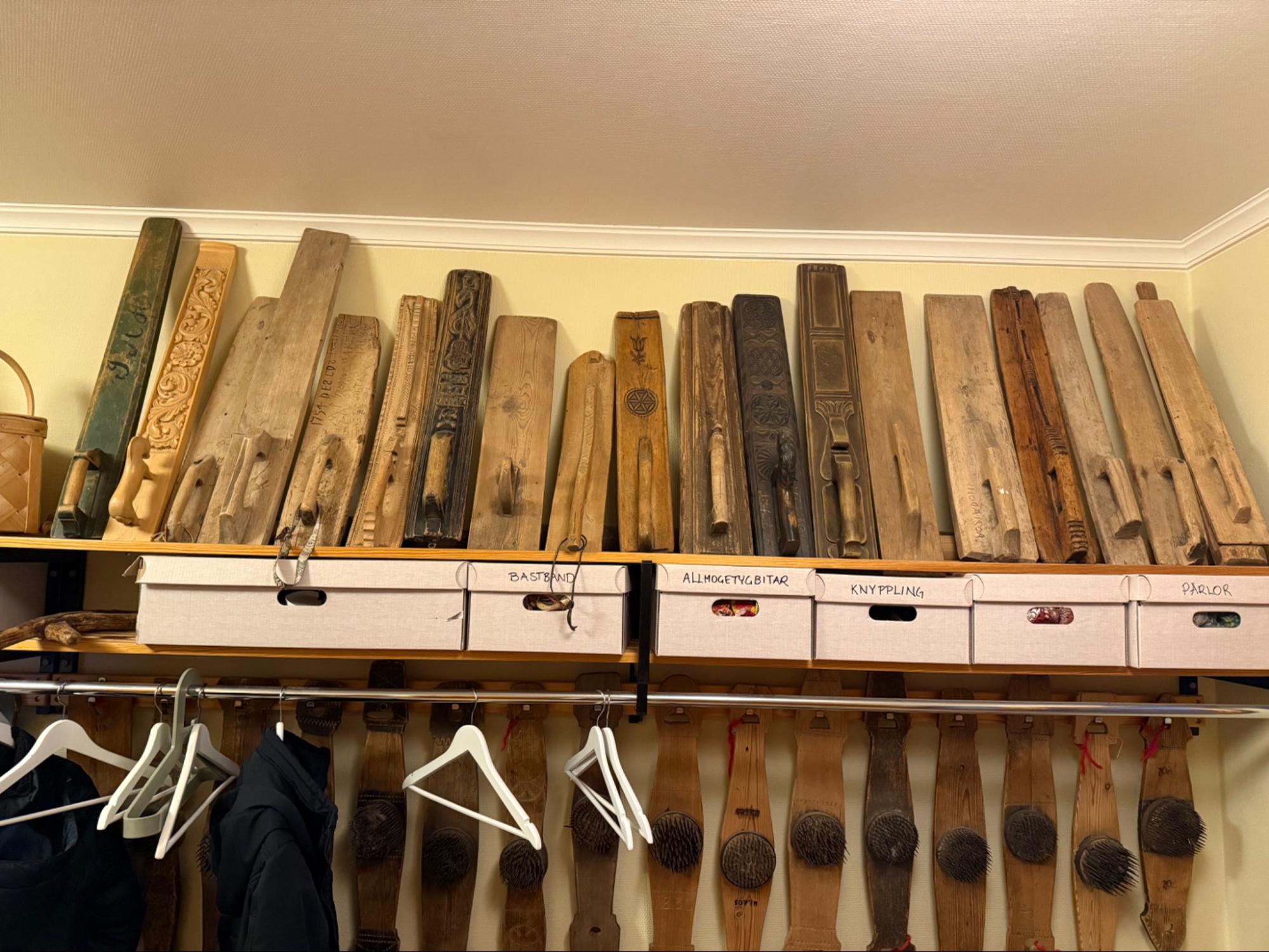
Above: From Kirsi Manni's private collection
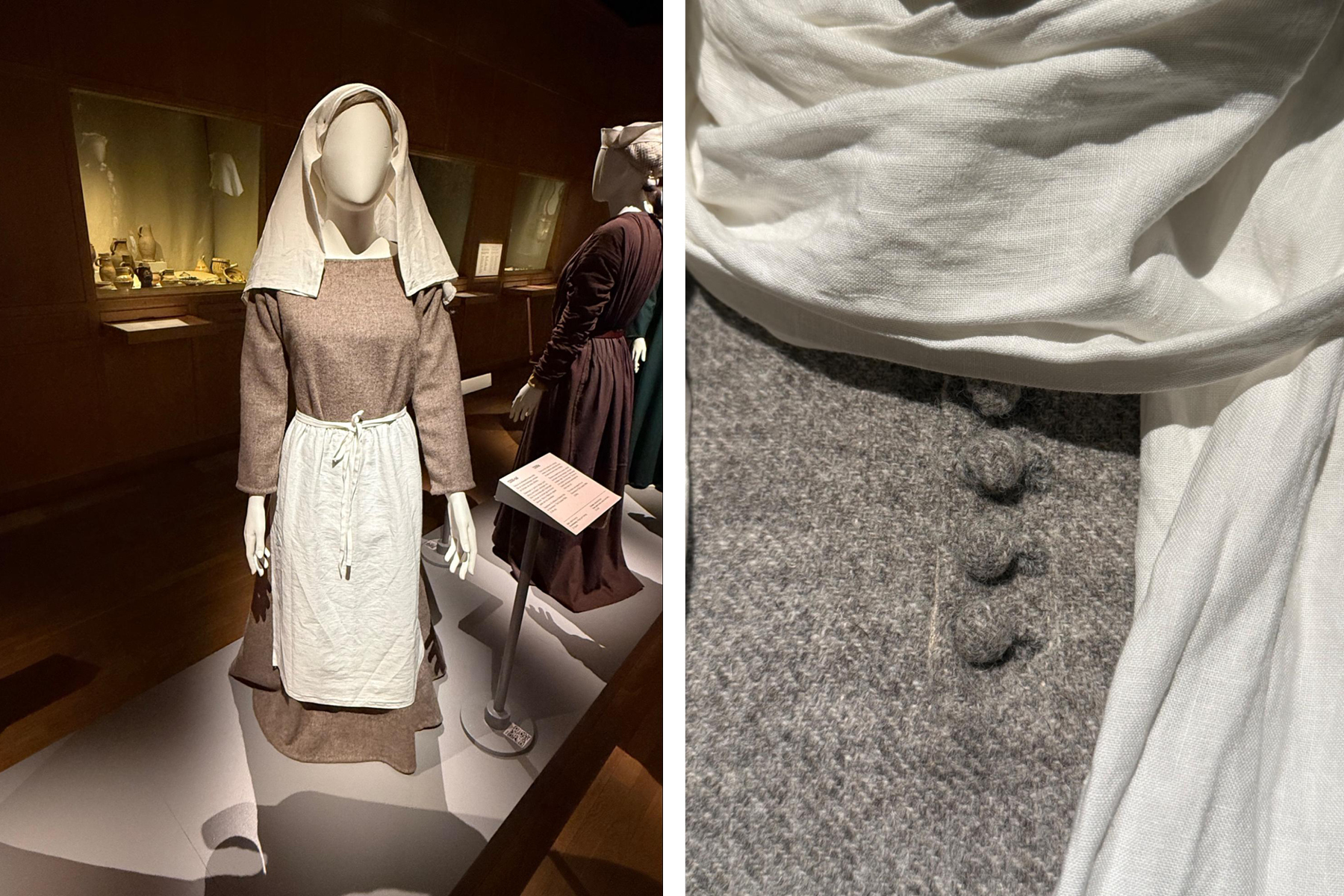
At the Swedish History Museum there was an exhibit of medieval women’s clothing, from 1027 to 1527 CE. The primary materials were wool and linen, and displayed the changing styles and construction of the time. In the handmade era, many skills had to be employed to make these pieces: from spinning to weaving, sewing to embroidery, and tanning to blacksmithing. I have a keen interest in making both modern and historic clothing with my handwoven cloth, so this exhibit was very engaging.
Another highlight was a visit to Växbo Lin, one of three linen mills in Sweden (about 3 hours north of Stockholm). This mill was opened in 1990 in an effort to preserve the knowledge and industry of linen weaving in Sweden. Seeing the machines at work and the variety of woven fabrics was inspiring. In my own weaving I often explore materials and keep the structure and colors simple. Sometimes I wonder how this kind of weaving fits in a world that values more busy color and pattern. When I saw the plain weave dinner napkins in the shop, also of plain weave and in gentle colors, akin to my own aesthetics, it was like someone reached in and gave my heart a little pump. In terms of my mystery novel analogy, I felt like I was onto something.
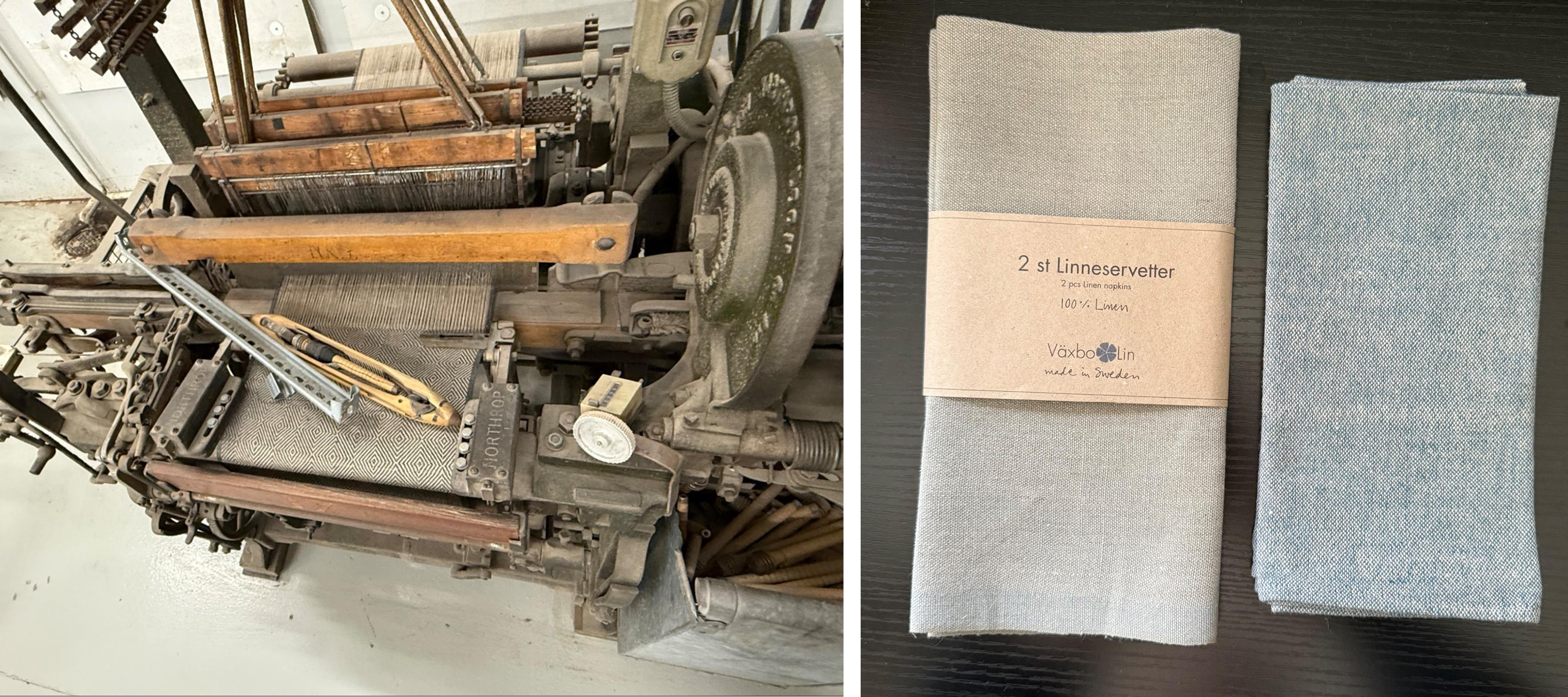
Left: Växbo Lin mill loom, Right: Växbo Lin dinner napkins (on left) & my woven cottolin dinner napkins (on right)
I also had the good fortune to speak to many talented weavers during my trip. These conversations about my personal journey and about weaving in the world today were essential. My thanks to the weavers who took time to meet, chat, and engage in conversations that expanded my mental landscape and gave me a sense of connectedness.
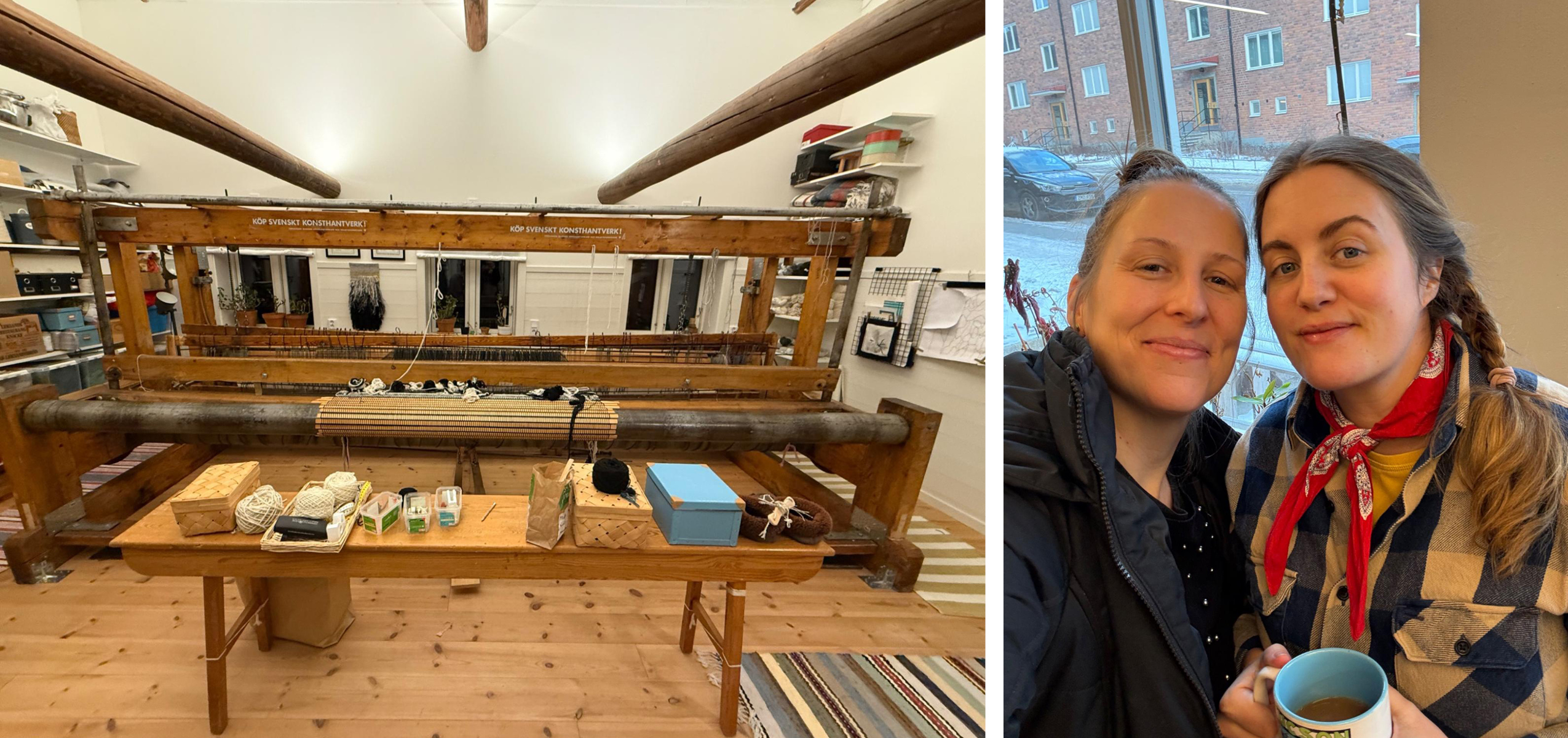
Left: Maria Jufvas studio & loom, Right: Miriam Parkman & I