

A Brief History of Looms: From Weaver-Controlled to Loom-Controlled
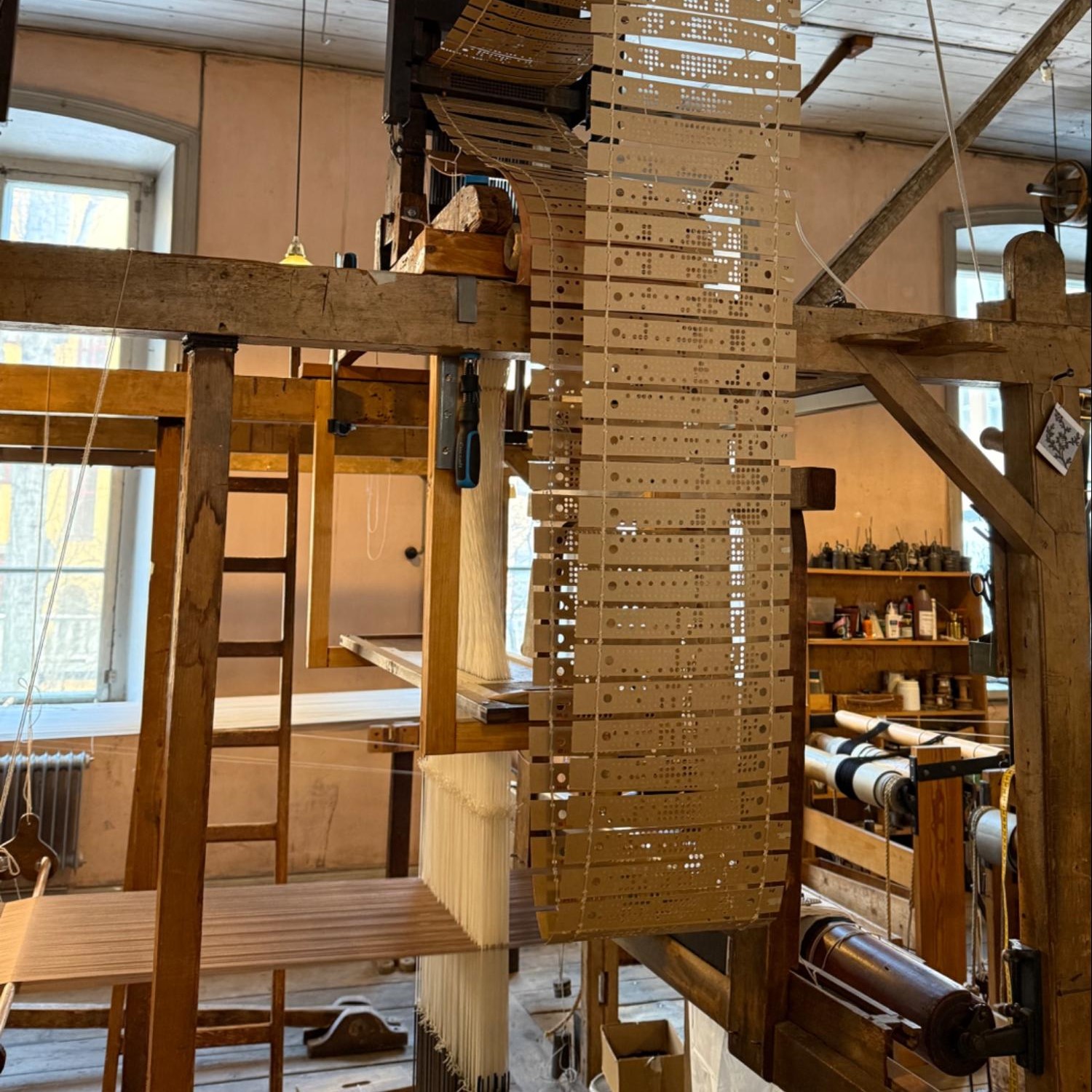
Loom technology has changed drastically over time, from completely hand-operated to modern and mechanized. In this blog post, Josie Cooke wonders: which weaving tools make the most sense for her craft?
Good day friends,
There is a topic I have been pondering, which was expanded on during my journey in Sweden. That topic is tools. When you’re first starting out in a craft, the best tool is often the one you have, or can easily get. There’s no need to get stuck (for too long) in the trap of not starting because you don’t know which one you want, or which is best for the job. Almost any tool will provide you with the opportunity to learn a great deal, and from there, decide which direction to head next. I have been on my own tool exploration, trying to find what method suits my needs and goals in weaving. In this blog, I’ll share glimpses of weaving tools through history with examples from Swedish museums, weavers’ studios, and a textilier.
Early weaving involved heddles and tablets for making bands: crucial elements in the tying of bundles and tethering of animals. A simple but clever loom setup known as backstrap weaving allows for wider widths and incorporates the weaver as the tensioning element. This form of weaving continues to be practiced in cultures worldwide. Looms, as we know them, started out as four stakes in the ground with beams between them to stretch the warp. This evolved into the standing (or more accurately, leaning) version of a warp-weighted loom. Archeologists know these looms were leaned because warp weights, flat circular stones with a hole through the middle, are found along the wall in excavation sites.
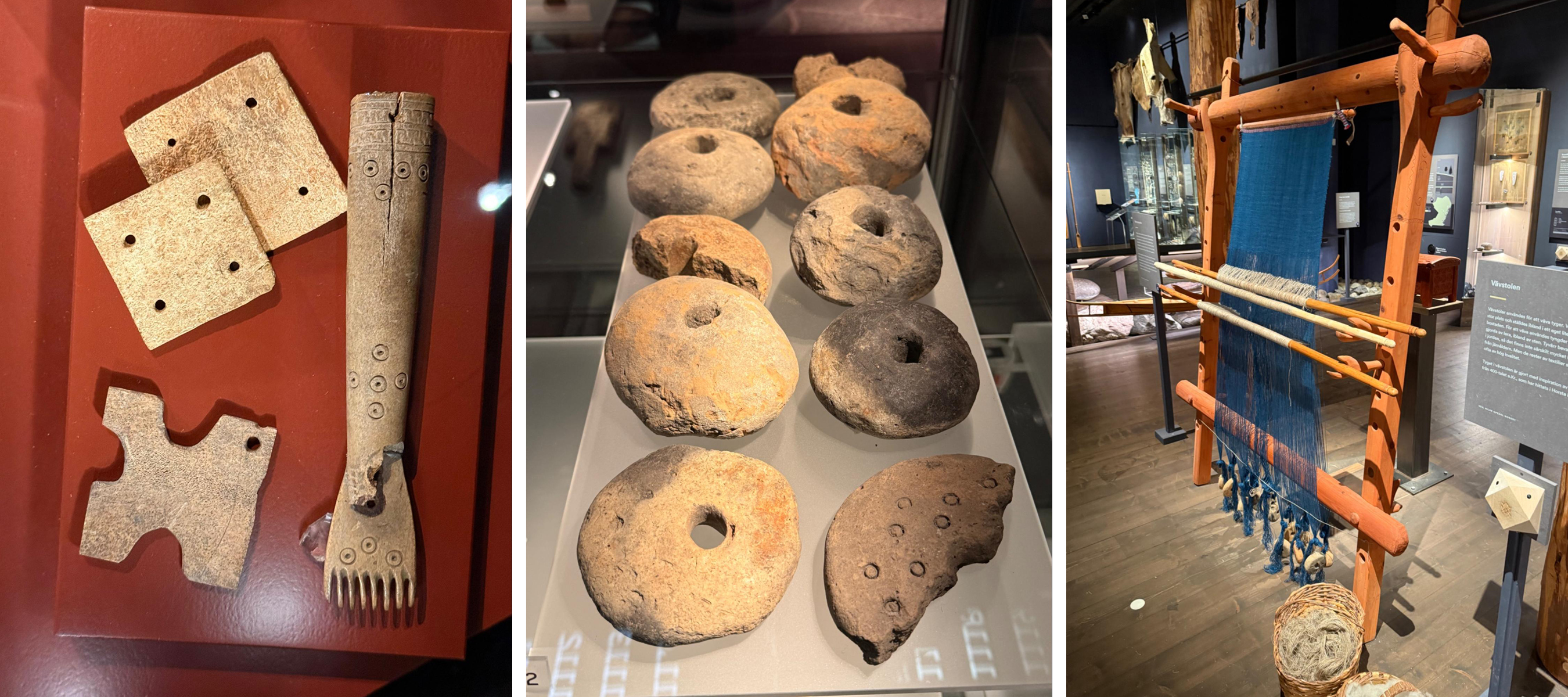 Tablet weaving tools and warp weights at Swedish History Museum, Stockholm. Warp weighted loom, recreation, Dalarna Museet
These looms slowly evolved into the horizontal version we are familiar with today, much like the one I currently use. Improvements continued to be made as experiments led to adopting or modifying components, giving us inventions like the flying shuttle, the cast iron pedal-powered Hattersley loom, the Jacquard mechanism (for individual thread control—think pixels in a photo), the compu-dobby (a home version computer-controlled loom), and the TC2 (a digital weaving machine). The difference amongst these looms is the degree to which they are weaver-controlled or loom-controlled when weaving.
For many weavers, which loom to use and what kind of weaving to do is decided by what they enjoy, and what tools they need to make it. Sometimes this is determined by material choice. While in Sweden, I was introduced to some new looms and techniques that expanded my horizons. Large looms (think 14+ feet wide) are used for large projects using thick wool and a heavy beat. A stunning example is on display at Dalarna Museum: Helena Hernmarck’s “Mossklyftan.”
 Helena Hernmarck’s “Mossklyftan” far and close up
Silk threads, fine as spider web, are weighted by lingoes (long metal rods attached to cords that go around each thread) and controlled by patterning cards (determining which threads go up and thereby show on the surface of the cloth as it’s made). This system is a type of Jacquard loom, a technology integral to the development of computers. No longer in use, these looms are on display at K. A. Almgren Silk Museum in Stockholm.
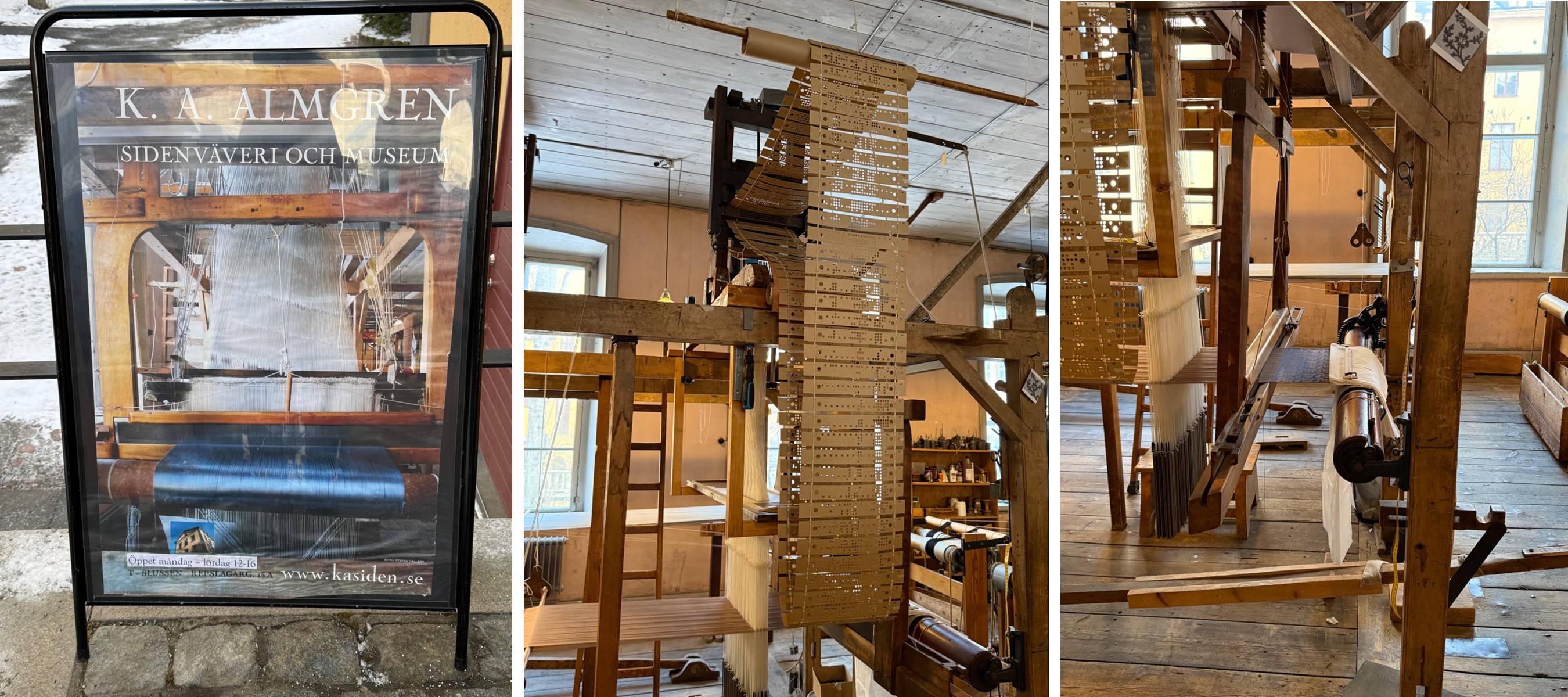 K.A. Algren Silk Museum, silk loom punch cards control which threads get raised, weights (lingoes) for individual threads
As production remained the guiding principle for most weaving, it led to innovations in mechanization. This was interesting to see at the Växbo Lin factory, both in their “oldest loom” and the ones they use to weave linen today. To see a video of one of their looms in action, see my post on Instagram.
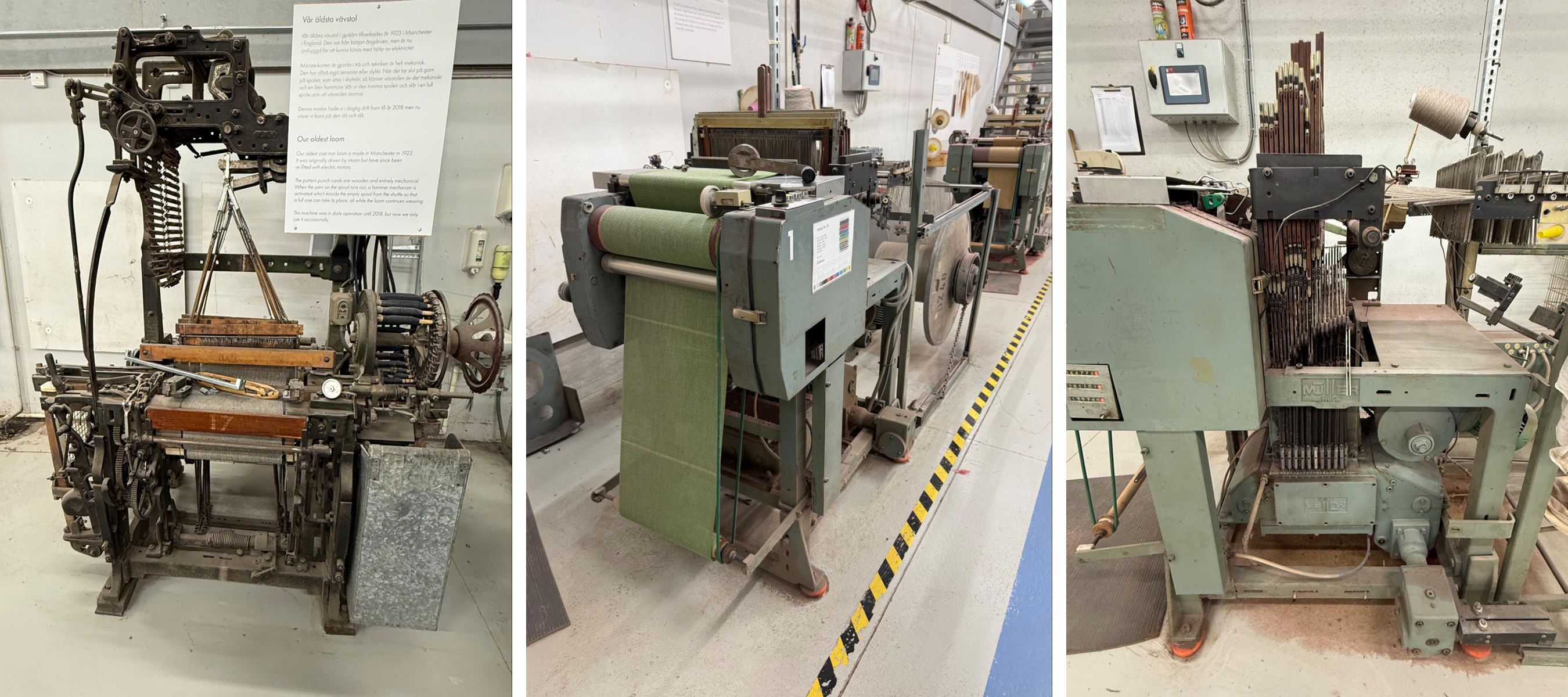 Växbo Lin’s oldest loom, made in Manchester in 1923, originally driven by steam, refitted with electric motors (left). Two Müller Frick looms, from Switzerland (center, right)
When I first started weaving, I had a 4-shaft Leclerc Artisat loom that was so light it slowly inched across the room with every thump of the beater (packing the weft material into the warp). For a time, I had an 8-shaft table loom, which was more versatile and portable for taking workshops far afield. From there, I got a Glimåkra Standard countermarch, which is unique in that every thread is either being lifted up or pulled down to make an opening to throw the shuttle through (instead of some threads going just up or just down). This loom is heavy, does not inch across the floor, and is capable of weaving everything from fine linen to heavy rugs. In the realm of loom technology nowadays, however, it is unquestionably on the analog end of the spectrum.
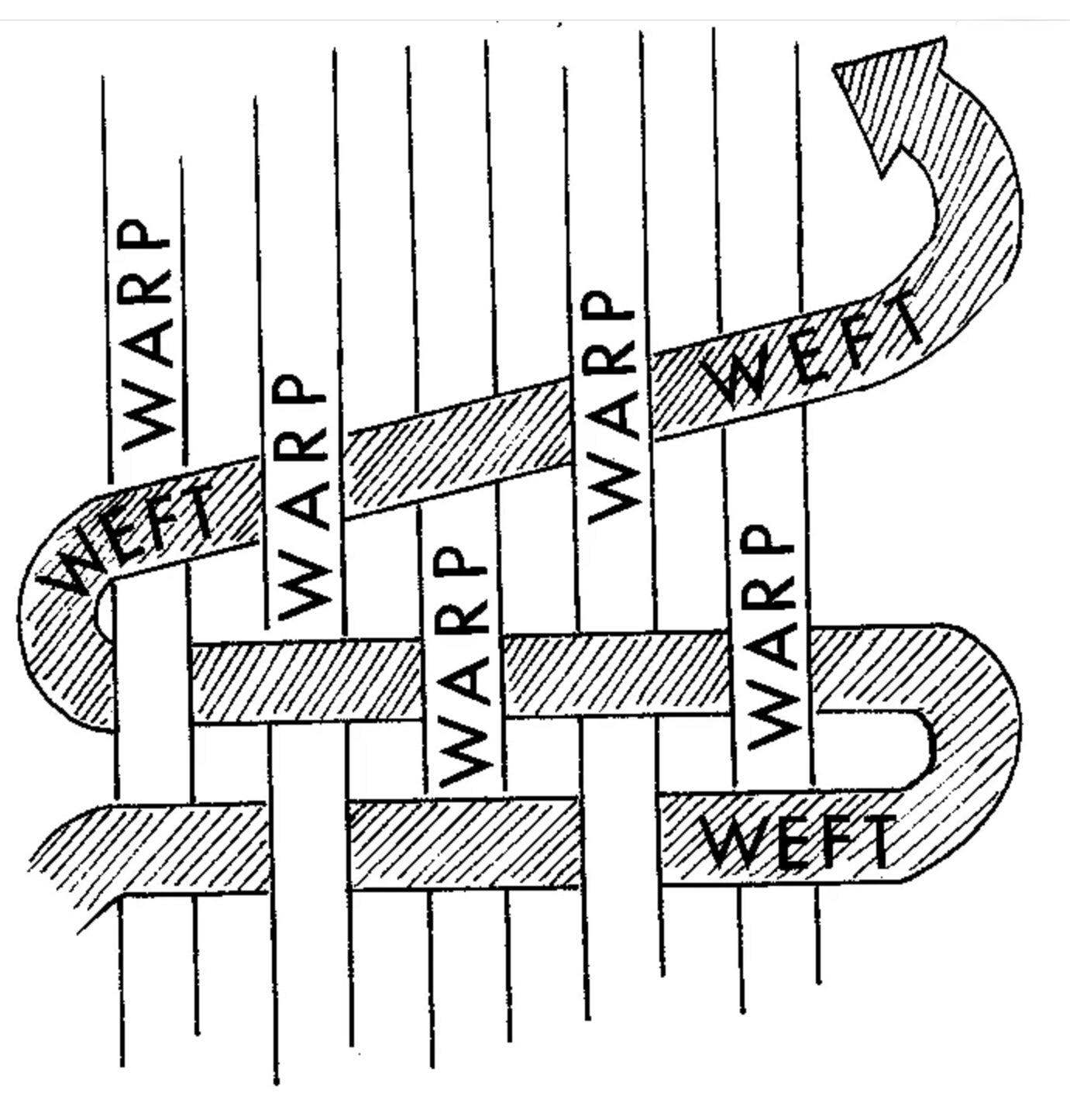
I certainly have not outgrown my loom, but I am pondering what is out there, and where I want to put my time and energy. Some answers you come by through exploration. Would I find a flying shuttle accelerates production without diminishing enjoyment, or that a pedal-powered Hattersley would clear the path to create bolts of material for clothing? How primitive or advanced do I want my tools to be, and what are the advantages of both? How do I find a balance between production and method? Is there a way to use these tools to combat fast fashion, while maintaining the values and joys that brought us to weaving in the first place? I plan to explore these thoughts during my residency, through visits to weavers, weaving schools, and museums.
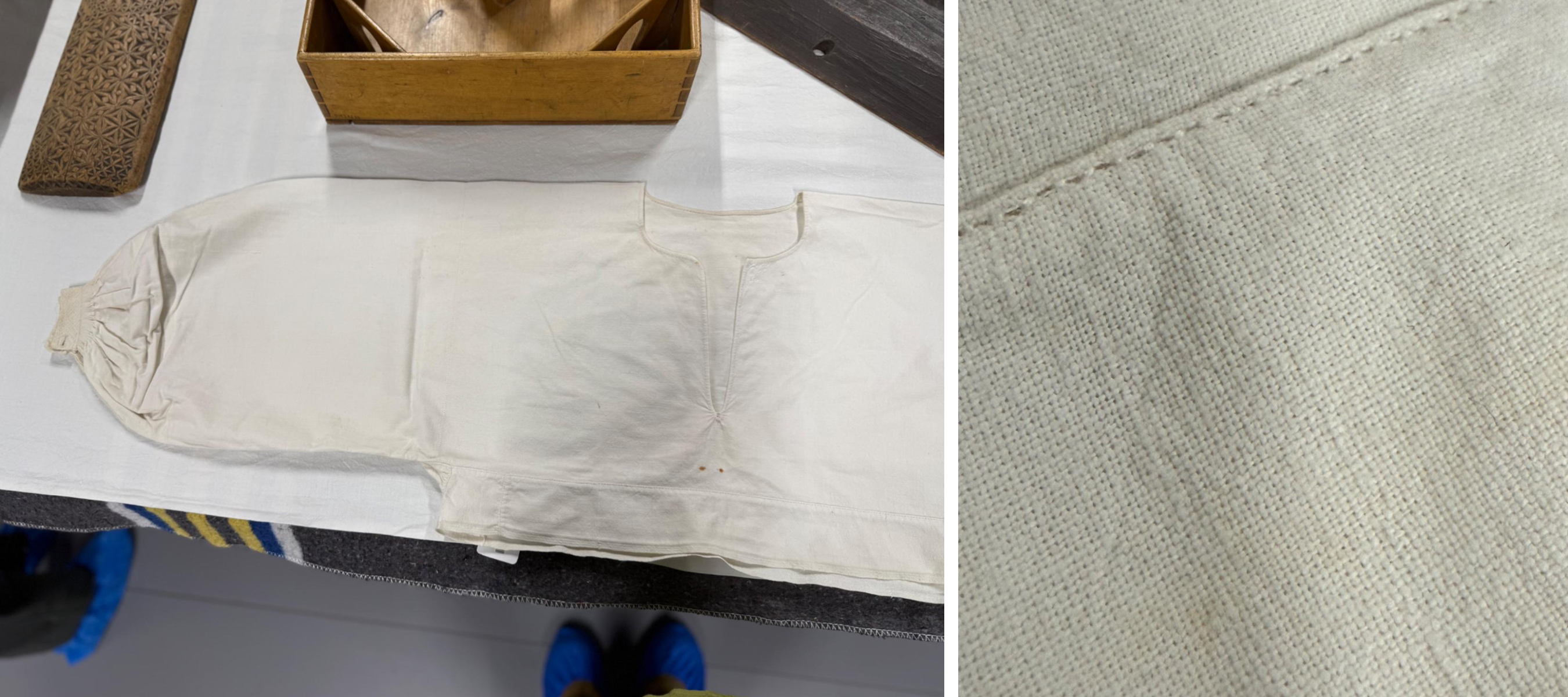 Västernorrlands Museet archives, överdel “top”
In Sweden, I also had the opportunity to consider: what is the end product, and why? In museums, the textiles that are preserved are often in the form of clothing. We had the pleasure of examining some archive pieces at Västernorrlands Museet, where I viewed an överdel (“top”). This is akin to the simple garment construction I am currently exploring.